Verify Credentials
Ask for the ROC license number and verify it through the Arizona Registrar of Contractors. Request current proof of liability insurance and workers' compensation before signing.
Choose a floor installer by verifying credentials, reviewing experience with your exact flooring material, and comparing detailed written quotes. Phoenix Expert Flooring brings installation and repair experience from homes and businesses across the Salt River Valley, including historic bungalows near Encanto Park and new-build subdivisions in Ahwatukee, to help Phoenix customers recognize the details that separate a dependable installer from a risky choice.
Ask for the ROC license number and verify it through the Arizona Registrar of Contractors. Request current proof of liability insurance and workers' compensation before signing.
Match the crew's experience to your material and subfloor. Review close-up photos of transitions, thresholds, and baseboards instead of relying only on polished room photos or star ratings.
Compare scope, not just the final total. Each quote should show subfloor leveling, moisture barriers, transition strips, haul-away, schedule, and written warranty terms where applicable.
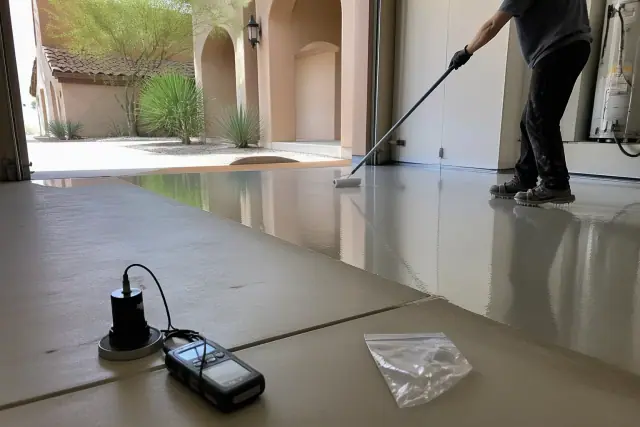
A calibrated moisture meter and job-site humidity reading show whether a slab is ready. These checks matter before hardwood, laminate, vinyl plank, and floor repairs.
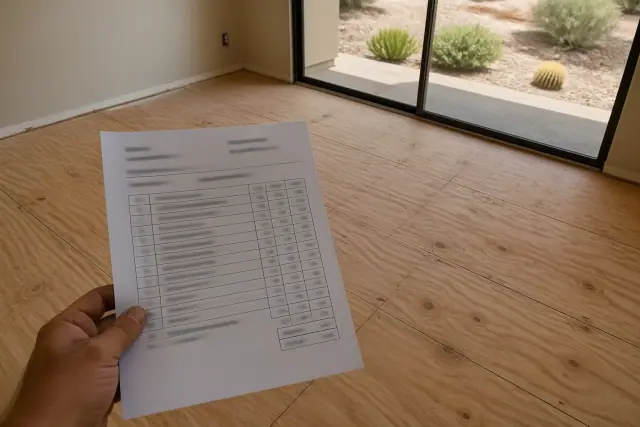
A useful quote separates material, labor, subfloor preparation, transitions, disposal, and schedule. That detail exposes omissions before they become change orders.
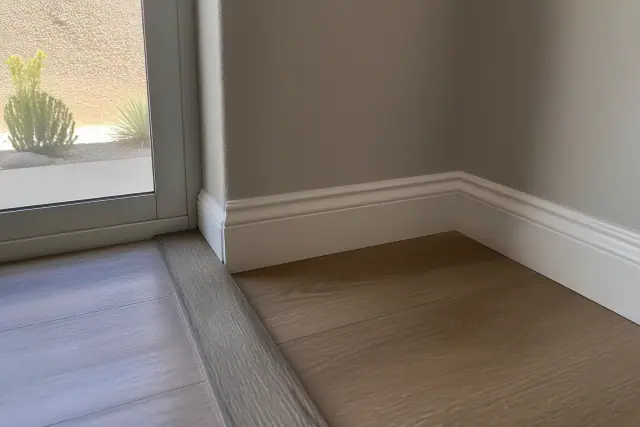
Close-up portfolio images should show straight transitions, clean thresholds, and careful trim work. Those details reveal installation quality better than wide room photos alone.
Verify the active state license and request a current insurance certificate tied to you or the project address.
Ask for two or three completed Phoenix-area addresses plus detail photos from projects using the same flooring and subfloor type.
Labor across flooring types can run between $0.60 and $4.00 per square foot before materials, so the scope behind each number matters.
Most single residential rooms take one to three days; hardwood refinishing often adds a couple of curing days before furniture returns.
| Check | Strong Evidence | Warning Sign |
|---|---|---|
| Credentials | Active Arizona license and current insurance certificate | Numbers or coverage cannot be verified |
| Relevant work | Recent local references and close-up photos for your material | Only star ratings or distant glamour shots |
| Written scope | Materials, labor, subfloor prep, disposal, and timeline are separate | Low total with important work omitted |
| Crew and warranty | Crew status and workmanship terms are written down | Vague answers about subcontractors or corrections |
Start with three filters: licensing, insurance, and demonstrated experience with your exact material. Verify the ROC number through the Arizona Registrar of Contractors and ask for general liability and workers' compensation documentation. Then confirm who will arrive at the property, how many similar jobs that crew has completed, and whether the company has a physical Phoenix-area presence. A reliable candidate should explain the installation method, provide recent local references, and put the scope and workmanship warranty terms in writing.
The right experience depends on the material, subfloor, traffic, and Phoenix conditions. Hardwood over a slab calls for moisture testing and typically several days of on-site acclimation; tile requires careful substrate preparation, thin-set coverage, and movement-joint planning; laminate needs underlayment and expansion gaps; and carpet should be power-stretched to reduce rippling within the first year. For jobs over a few hundred square feet, compare two or three bids line by line: laminate is typically around $4.05 per square foot installed, with labor between $2.00 and $3.00 per square foot and materials around $1.50, while hardwood quotes generally range from $6 to $25 per square foot including materials and labor. Treat those figures as context, because species, finish, floor removal, moisture barriers, leveling, and subfloor condition can change the project-specific quote.
Which credentials matter? National Wood Flooring Association training focuses on hardwood installation, sanding, finishing, and moisture protocols, while Certified Flooring Installers training covers a broader mix of materials; neither replaces Arizona license and insurance checks. Engineered or solid hardwood? Engineered hardwood generally handles moisture movement over common Phoenix concrete slabs better, while solid wood can work over a suitable wood subfloor after proper acclimation. Is refinishing worth considering? Properly sanded and resealed solid wood can gain 20 to 30 years of useful life, but the installer should check board thickness before choosing a full sand instead of a screen-and-recoat.
Share your measurements, flooring material, subfloor conditions, and quote questions. A straightforward Phoenix flooring consultation can help clarify installation options and the scope to confirm before you approve work.