Verify Credentials
For Arizona work over $1,000, ask for an active Registrar of Contractors license number and verify it yourself. Request current liability and workers' compensation documentation as well.
Phoenix Expert Flooring recommends verifying credentials, comparing a complete written scope, and asking how the installer will handle your flooring material and subfloor. These questions matter in Phoenix because skipped moisture testing, acclimation, preparation, or warranty details may not become visible until weeks or months after the work.
For Arizona work over $1,000, ask for an active Registrar of Contractors license number and verify it yourself. Request current liability and workers' compensation documentation as well.
Require an itemized estimate that separates labor, flooring, subfloor preparation, removal, furniture moving, and appliance work. The contract should also identify payment milestones and warranty responsibilities.
Ask who will perform the installation, what experience that crew has with your material, and how it will test and prepare the subfloor. Confirm acclimation, installation method, schedule, and workmanship coverage before work starts.
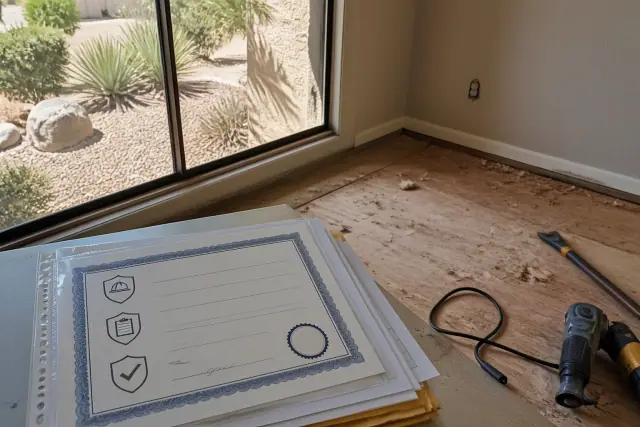
A license record, liability certificate, and workers' compensation proof let a homeowner verify credentials instead of relying on a verbal assurance.
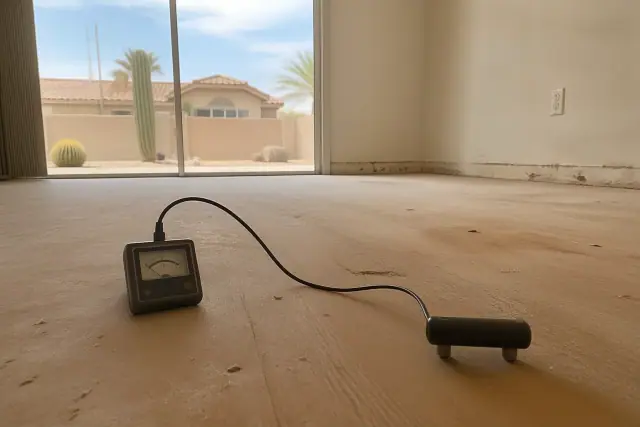
Moisture readings and a straightedge check reveal slab conditions that a bid should address before installation. The flatness discussion should cover a 3/16-inch tolerance over 10 feet.
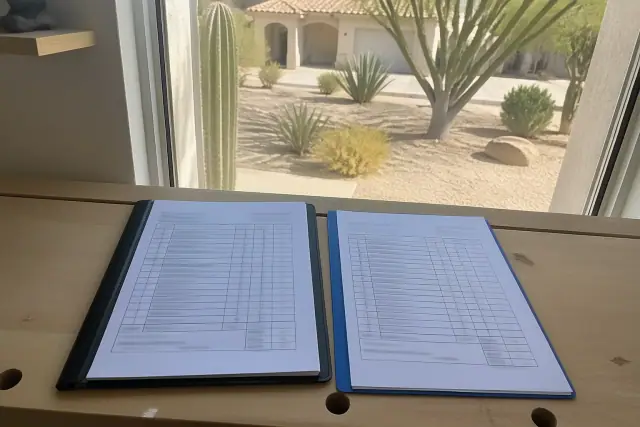
Placed side by side, itemized estimates make labor, flooring, subfloor preparation, removal, and warranty scope easier to compare.
Verify the Arizona license number and request certificates for liability and workers' compensation coverage rather than accepting a verbal claim.
Ask how many comparable projects the contractor has completed with your flooring type and which preparation and installation standards the crew follows.
Ask for a written schedule tied to payment milestones. A 10 to 30 percent deposit is standard; never pay the full amount before work begins.
Walk away from a missing license, no written contract, full upfront payment, same-day pressure, a dramatically low bid, or silence about subfloor preparation and moisture testing.
| Flooring Type | Questions to Ask |
|---|---|
| Hardwood | Species and grade, acclimation time, moisture test, and NWFA installation standards |
| Luxury vinyl plank | Wear-layer mil rating, click-lock versus glue-down, and concrete-slab preparation |
| Porcelain or ceramic tile | Thin-set, TCNA method, wet-area membrane, grout, and expansion joints |
| Carpet | Padding density and thickness, seam placement, and power-stretch installation |
| Laminate | AC wear rating, underlayment, and a moisture barrier for slab foundations |
| Epoxy coating | Diamond grinding versus acid etching, ASTM F2170 moisture testing, and cure times |
| Hardwood refinishing | Sanding grit sequence, dustless sanding, and oil-based versus water-based finish |
| Floor repair | Damage cause, subfloor condition, and whether the existing material and finish can be matched |
The questions asked before installation can prevent a callback six months later. A floor may look acceptable on day one yet develop cupping, hollow spots, or delaminating planks weeks or months later when flatness, moisture, or acclimation was skipped.
Material and preparation drive pricing: LVP typically runs $3-$7 per square foot installed; porcelain and ceramic tile $7-$15 depending on grade and layout; hardwood $8-$14; carpet and laminate $3-$6; and epoxy coatings $3-$12 depending on coats and decorative broadcast. Old tile removal is usually separate at roughly $1.25 per square foot. For an average-sized home, LVP typically takes one to three days, while tile takes three to five days including thin-set cure time. Hardwood needs 24-48 hours of acclimation plus three to seven installation days depending on square footage; epoxy needs 24-72 hours between coats and five to seven days of full cure before heavy foot traffic returns.
How many bids should you get? Compare itemized estimates from at least three contractors. Which references matter? Request three similar projects completed in the last 12 months. Also ask whether employees or subcontractors will install the floor, whether moving, appliance disconnection, and haul-away are included, and which cleaning, moisture, or furniture conditions could void the separate workmanship and material warranties.
Share the flooring type, subfloor condition, and itemized scope you are considering. A local flooring professional can help you identify missing preparation, schedule, or warranty questions before you approve the work.