Tile for Overall Performance
Ceramic and porcelain tile stay cool, resist heat damage, and tolerate Arizona's seasonal moisture changes.
At Phoenix Expert Flooring, the practical answer depends on sun exposure, concrete-slab conditions, moisture, and how each room is used. Tile is the strongest overall choice for Arizona homes, while luxury vinyl plank is the leading wood-look alternative for the Phoenix climate.
Ceramic and porcelain tile stay cool, resist heat damage, and tolerate Arizona's seasonal moisture changes.
Luxury vinyl plank provides a wood-look surface with a waterproof core suited to monsoon humidity swings.
Compare slab moisture, direct UV exposure, climate control, room use, and likely water exposure before choosing a material.
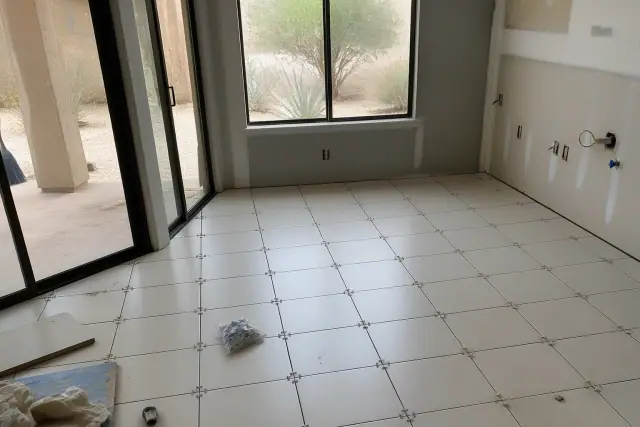
A sunlit room shows why direct UV exposure and slab heat should be compared before selecting a floor.
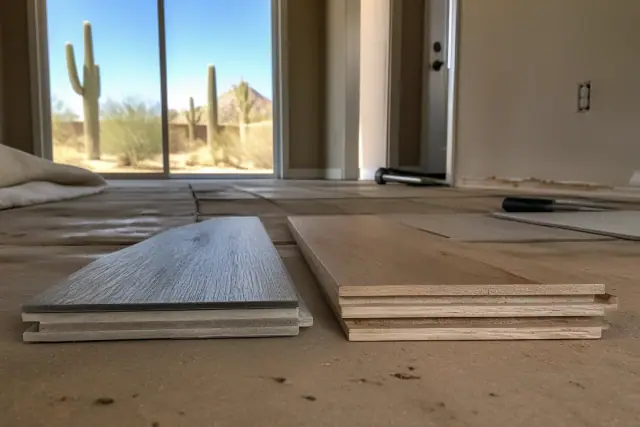
Layered samples make the waterproof LVP core and cross-layered engineered hardwood construction easy to compare.
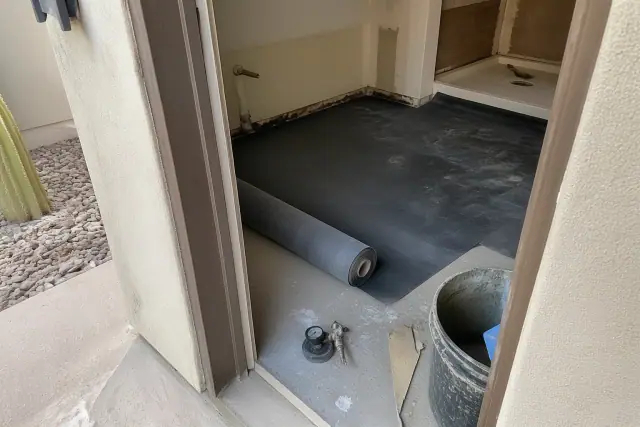
A slab assessment helps identify moisture conditions that could affect the material recommendation.
Phoenix summer highs regularly reach 110-115°F, while slab temperatures can climb even higher under west-facing windows.
Relative humidity is typically 10-20% for most of the year, then rises to 40-50% for days at a time during July through September monsoon storms.
Concrete-slab moisture, south- or west-facing glass, year-round climate control, room traffic, and water exposure can all change the best fit.
Installed ceramic tile runs from roughly $10 per square foot, natural stone from $35-$50, and laminate material from $0.70-$2.50 per square foot.
| Room or Condition | Strongest Fit | Why It Fits |
|---|---|---|
| Kitchens, entries, and living areas | Ceramic or porcelain tile | Stays cool underfoot and resists heat and monsoon moisture. |
| Wood-look interior rooms | Luxury vinyl plank | Its waterproof core handles moisture without warping. |
| Humidity-sensitive living spaces | Engineered hardwood | A cross-layered core handles humidity swings better than solid hardwood. |
| Low-moisture, light-use rooms | Laminate | Can work where water exposure is unlikely. |
| Garages, patios, and commercial spaces | Epoxy or coated concrete | Matches the hard-working surfaces common in these settings. |
Tile is the strongest all-around option and is common in kitchens, entries, and living areas across Phoenix, Scottsdale, and Chandler. LVP is the practical wood-look alternative, while engineered hardwood is more stable through humidity changes than solid hardwood. Laminate can work in dry rooms but may swell after water exposure, and epoxy or coated concrete is the standard choice for garages, patios, and commercial spaces.
Phoenix sits in the Salt River Valley of the Sonoran Desert in Maricopa County, so a floor must handle prolonged dryness as well as short monsoon humidity spikes. Slab moisture, direct UV through south- or west-facing glass, and year-round climate control matter as much as appearance. A lightly used guest room can need a different material than a great room facing the McDowell Mountains through floor-to-ceiling glass.
Is solid hardwood a good choice? It tends to struggle with Arizona's humidity swings, while engineered hardwood's cross-layered core handles them better. Can laminate work here? Yes, in low-moisture rooms, but it can swell quickly after taking on water. For a garage, patio, or commercial floor, epoxy and coated concrete are the standard choices described in this guide.
Share how the room is used, whether it sits on a concrete slab, how much direct sun it receives, and where moisture is likely. A local flooring evaluation can help match those conditions to the right material.